
Comparison · iPhone & iPad
Nightcore vs sped up:
1.33 semitones apart.
Same dial, same direction, two stopping points — 1.25× at +3.9 st against 1.35× at +5.2 st. Everything else follows from that gap.
Free to use. Pro is one payment — forever.
- Sped Up — +3.9 st
- Nightcore — +5.2 st
- 1.33 stall that separates them
There is no second mechanism
The comparison most people expect — one changes the key, the other leaves it alone — is not the comparison. Both change the key. They differ by how far.
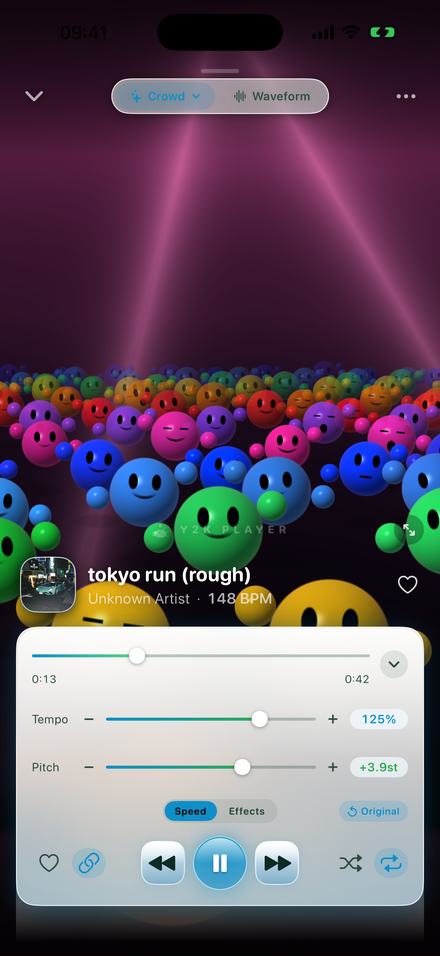
In Y2K Player the two are neighbouring chips built the same way. Sped Up sets the tempo to 1.25×. Nightcore sets it to 1.35×. Both switch on the speed-and-pitch link, which is the record-player behaviour: the platter turns faster, every frequency in the recording is multiplied by the same number, and the voice climbs in register along with the drums.
Which means a sped up edit is already a transposed song. At 1.25× it sits nearly a major third above where the record started — a number that never gets quoted, which is how the folk definition survived this long.
What the engine does in that moment is worth knowing, because it decides how both hold up. With the link on and no pitch offset dialled in by hand, nothing is time-stretched at all: the whole change is carried by resampling, and the time-stretcher sits at unity doing nothing. Neither preset can produce the smeared transients and watery top end that stretching a song by a third would give you, and the stretch-quality switch in Settings changes nothing for either, because there is no stretching there to improve.
1.25× and 1.35×, converted
Speed becomes pitch on a fixed curve — twelve semitones per doubling — so the shift is twelve times the base-two logarithm of the tempo. Both presets through that formula:
- Sped Up at 1.25× lands on +3.86 semitones. The readout rounds it to +3.9 st. A shade under a major third.
- Nightcore at 1.35× lands on +5.20 semitones, shown as +5.2 st. A shade over a perfect fourth.
The entire genre boundary is 1.33 semitones, and 8% of tempo. Written down that is nothing. In the ear it is not, because a fourth up is roughly where a chest voice starts reading as somebody else, and a third up is roughly where it still reads as the same singer having a better day.
What it does to the clock and the grid
Two consequences, both printed on screen while you listen. The BPM line under the song title is recomputed against the current speed, so a 96 BPM source reads 120 under Sped Up and 130 under Nightcore; a 160 BPM source reads 200 and 216. The time remaining is stretched too: a 3:30 track runs 2:48 at one preset and 2:36 at the other.
Those numbers settle the argument faster than any description of the sound. Past roughly 175 BPM a busy arrangement stops being separable — the hats stop being hats and turn into a shimmer — so on fast material Nightcore is not the bolder choice, it is the worse one. On something that started at 80 or 90, both are comfortable and the decision is genuinely about the voice.
Hearing them against each other
Under a minute, on one song, with nothing rendered in between.
- Add the songTap Add and pick the file, or share it in from wherever it lives. It is copied into the app once and only read after that.
- Read the tempo under the titleThe line beneath the song name carries its BPM. Multiply it by 1.25 and by 1.35 now — those two numbers are most of the decision.
- Check the link is onThe chain button beside the transport ties pitch to tempo, and it is on by default. Both of these edits need it on; with it off you get a faster song in its original key.
- Set 125% and listenDrag Tempo until the readout says 125%. The pitch figure beside it moves to +3.9st on its own. It changes under your finger — nothing is rendered first.
- Push on to 135%The same drag, ten points further. Pitch reads +5.2st. Go back and forth a few times: the gap is far easier to hear as a switch than as two separate listens.
- Keep the one you wantThe setting stays with that song, so it opens the same way next time. Export writes an M4A or a WAV with the speed and the key rendered into the file.
They sit next to each other in one row
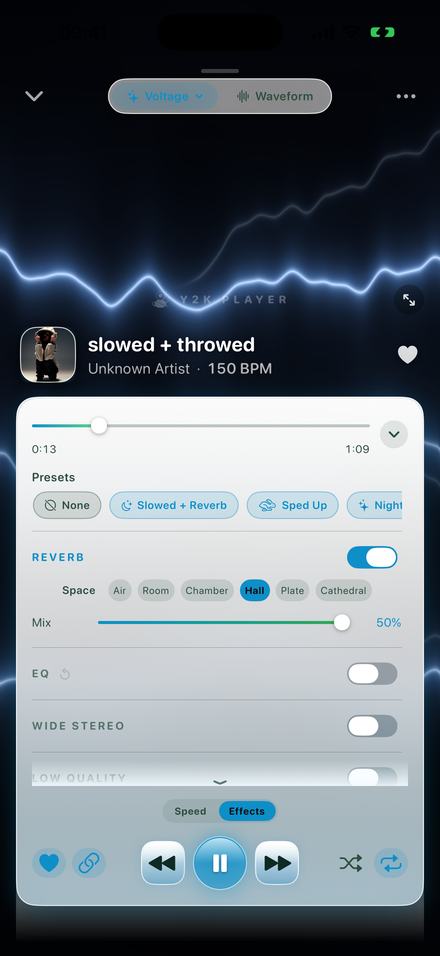
None first, then Slowed + Reverb, then Sped Up, then Nightcore — and each chip wipes the rack clean before writing its own, so tapping one after the other is a swap rather than a stack.
The difference nobody writes about: the tone curve
Speed is not all a preset sets. Each also writes a five-band EQ, and the two curves are different shapes. That is the part that makes the Nightcore chip sound deliberate rather than merely faster.
The bands sit at 80 Hz, 250 Hz, 1 kHz, 3.5 kHz and 10 kHz, and the outer two are shelves rather than bells, so they tilt everything below and above them instead of poking a hole.
- Sped Up: −1 dB on the 80 Hz shelf, flat at 250 and 1 k, +2 at 3.5 kHz, +3 on the 10 kHz shelf.
- Nightcore: −2 dB at 80 Hz, −1 at 250, flat at 1 k, +2 at 3.5 kHz, +4 on top.
The same gesture, taken further: trim the bottom, open the top, with Nightcore doing twice as much of the first and a decibel more of the second. It has to. Raising the replay rate carries the low end up with everything else, so a kick resting at 50 Hz arrives at 68 and reads as boxy where it used to read as deep. Pulling that shelf down is what stops the faster version sounding thin and cluttered at once — the failure mode of every fast edit made by dragging one slider and stopping.
Speed and pitch are free; the rack that carries those curves is the Pro half of the app. A free drag to 135% gives you the whole transposition and none of the tilt.
Choosing between them without guessing
Read the source tempo first. It is printed under the title before you touch anything. Multiply it by 1.25 and by 1.35 and look at the two answers rather than the two names. Anything landing above about 175 has already answered you.
Then decide what the vocal is for. If the song should feel quicker and more urgent while staying that artist’s record, 1.25× is the ceiling. If the point is a new character — lighter, younger, further from the original — that is what the extra 1.33 semitones buys, and taking less of it just makes a slightly odd sped up edit.
Then look at the arrangement. A sparse track with air in it takes 1.35× and gains energy. A dense mix with layered percussion loses legibility long before the voice gets interesting.
Neither, exactly
The presets are opinions, not walls. The tempo slider runs 50% to 150% under your finger, and with fine control steps on it moves in 1%, so 128% or 132% is available the moment you want the ground between them.
There is also a third answer the versus framing hides: switch the link off and the speed changes while the key stays exactly where the record left it — a fast song rather than a transposed one. Whatever you land on can be saved as your own chip, holding the speed, the key and every effect as they stand, and the None chip puts the song back to 100% and +0 st when you want the original as a reference.
Worth knowing before you install anything
- Both work on files you already own. Music inside a streaming subscription is locked to its own app and cannot be brought in here.
- The speed and pitch sliders are free. 1.25× and 1.35× are two drags away without paying.
- The EQ curve behind each preset belongs to the effect rack, which is part of Pro.
- Your original file is never rewritten. The speed and the key are stored beside the song and applied while it plays.
- Every song keeps its own setting, so one track can stay at 1.35× while the rest of the library plays untouched.
- It all runs on the device. No account, no upload, and airplane mode changes nothing.
Nightcore vs sped up, answered
The questions that come before anybody installs anything.
What is the actual difference between nightcore and sped up?
Amount, not method. Both raise the playback rate and let the key ride up with it. The Sped Up preset stops at 1.25×, which is +3.9 semitones; Nightcore goes to 1.35×, which is +5.2. That is 8% more tempo and 1.33 semitones more transposition.
Does sped up change the pitch too?
Yes, whenever the speed-and-pitch link is on — and it is on by default. At 125% the readout shows +3.9st. The idea that sped up leaves the key alone describes what happens with the link switched off, which is a different edit.
How many semitones is nightcore?
+5.2 at the preset’s 1.35×. The curve is fixed at twelve semitones per doubling of speed, so the exact figure is 5.20 and the app rounds it to one decimal.
Is nightcore just a faster sped up edit?
Faster and higher. It is 8% quicker and a little over a whole tone above where a sped up edit lands, and its preset also tilts the tone curve further — more cut on the bass shelf, more lift on top.
Which one should I use on a fast song?
Sped Up. Multiply the BPM printed under the title: once 1.35× puts you past roughly 175, a busy arrangement stops being separable and the hats read as a shimmer rather than as hits.
Can I get nightcore speed without the higher key?
Yes — switch the link off and set the tempo to 135%. The song runs at that speed in its original key. It will not sound like nightcore, because the changed voice is the thing nightcore is for.
Do the two presets differ in anything besides speed?
They do. Each writes its own five-band EQ across 80 Hz, 250 Hz, 1 kHz, 3.5 kHz and 10 kHz. Sped Up takes 1 dB off the bottom shelf and adds 3 on top; Nightcore takes 2 off the bottom, 1 off at 250, and adds 4 on top.
Can I land somewhere between the two?
Yes. The tempo slider covers 50% to 150%, and with fine control steps switched on it moves in 1%, so 128% or 132% is one drag away. Whatever you settle on can be saved as your own preset chip.
Is either of them free?
Free to use. Pro is one payment — forever. The tempo and pitch sliders are in the free half of the app, so both speeds are available without paying; the EQ curve each preset writes belongs to the effect rack, which is part of Pro.
Does any of this need a connection?
No. The analysis, the speed change, the key change and the export all run on the device. There is no account and nothing is uploaded.
Will it change my original file?
No. The import is copied into the app’s own storage and then only read. The speed and the key are stored beside the song as settings.
What about daycore?
The same dial pulled the other way — speed and key down together. It is covered on the slowed and reverb page, along with the room that usually comes with it.
Where to go next
- Try it in your browserFree browser tools — try both sides of the line yourselfOpen →
- NightcoreThe 1.35× end on its own, full screen and exportable.Open →
- Sped up songsThe 1.25× end, and the file it produces.Open →
- Pitch changerMove the key with the tempo pinned where it is.Open →
- Slowed and reverbThe same dial pulled the other way, with a room around it.Open →
Two chips, 1.33 semitones apart.
Try both on a song you already own, and hear the gap as a switch instead of a description. Free to use. Pro is one payment — forever.
Free to download and keep. Pro is a one-time purchase — buy it once and it never renews.