
Glossary · Tempo, pitch and the words for them
Nightcore, daycore, chopped and screwed.
What the words actually mean.
Ten terms from the slowed-and-sped-up corner of music, defined once and defined properly — with the tempo and pitch figures that make each one what it is.
Free to use. Pro is one payment — forever.
- chopped and screwed
- nightcore, pitch linked
- an octave either way
Why these words never quite agree
Every term here began as the name of a technique and ended up as the name of a mood. The technique is the part that can be written down.
Ask ten people what nightcore is and you get ten answers, most about how it feels. Ask what it does and they converge at once: the song is faster and the voice is higher, and the second happens because of the first. That is the level worth defining these words at, because a mood cannot be dialled in and a tempo can.
Nearly all of them come down to three questions. How fast, relative to the recording? Does the pitch move with the speed, or stay put? Is anything added on top — a room, a degrade, a repeat? Ranges below are conventions, not rules. And one word here names a genre rather than an operation, so no setting will produce it; that entry says so.
The words, defined
Alphabetical. Where Y2K Player has a preset of the same name, its real numbers are given.
BPM
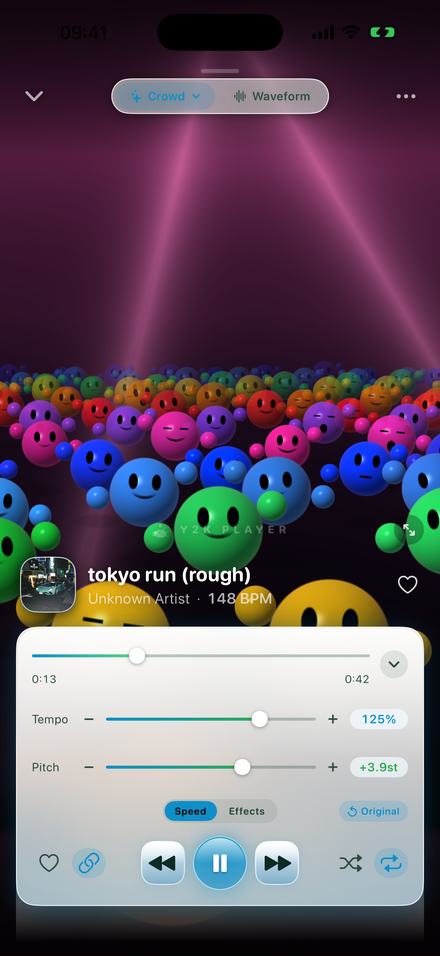
Beats per minute: how many times the main pulse falls in one minute. It measures tempo and nothing else — not key, not loudness, not genre. It is ambiguous by nature, because the same music supports counting the pulse at half or at double speed, which is why two apps can analyse one file and disagree by a factor of two. Y2K Player estimates across a 58 to 215 BPM range, reports nothing when there is no steady pulse, and shows what you are hearing rather than what the file was: a 120 BPM song played at 125% reads 150 BPM.
Chopped and screwed
A Houston technique from the early 1990s, associated with DJ Screw. Two operations, not one. Screwed is the whole record slowed down, the pitch dropping with it. Chopped is short passages caught and played again by hand — a stutter, a rewind, a bar doubled — on a second copy of the same record. Most of what circulates under the full name is only the screwed half. The Chopped preset does both: 0.72× with the pitch linked, and a chop locked to the song’s detected beat grid, capturing every eight beats in sixteenth-note slices.
Daycore
The inverse of nightcore: tempo and pitch pulled down together, so the song loses speed and drops in key at once. Also called anti-nightcore, it usually sits between 0.70× and 0.80×. What separates it from slowed and reverb is that daycore is about the changed voice, and needs no room behind it. There is no daycore preset in Y2K Player and none is needed — it is the tempo slider with the pitch link on, and at 0.75× the song lands five semitones down.
Lo-fi
Short for low fidelity: sound deliberately degraded — a ceiling on the bandwidth so the top end disappears, the swirl of low-bitrate encoding, added grit. It is a quality, not a tempo. That is the usual confusion: lo-fi hip hop, the playlist genre, is slow and degraded, so someone asking for a lo-fi version generally wants both. The Lo-Fi preset does both: 0.92×, with the Low Quality effect at an Age of 42 out of 100.
Nightcore
Speeding a song up so that its pitch rises with it. That link is the defining property, and the difference between nightcore and an ordinary sped up edit, where the pitch is usually held in place. It began with fans of eurodance and trance playing records faster, and takes its name from the duo the practice grew around. The usual range is 1.25× to 1.35×. The Nightcore preset sets 1.35× with the link on, which puts the pitch 5.2 semitones up.
Phonk
A genre, not an operation — the one word here that no setting will produce. It grew out of 1990s Memphis rap — cowbell, distorted 808s, chopped and pitched vocal samples, tape hiss — revived online from the late 2010s, with drift phonk as its faster, harder-distorted branch. Because phonk is a set of samples and arrangement choices, a song can be pushed closer to how phonk records sound but not converted into phonk. Y2K Player has no phonk preset; what overlaps is the Distorted preset — 0.94× with Drive at 46 — and the chop.
Semitone
The smallest interval in standard Western tuning: twelve to an octave, a frequency ratio of the twelfth root of two, about 1.0595. Pitch is measured in semitones rather than hertz because the ear hears ratios, not differences. Speed and pitch are one quantity when a file is read faster: the shift is twelve times the base-two logarithm of the speed. Y2K Player’s pitch control runs −12 to +12, and with the link on, 200% reads +12, 150% about +7, 125% reads +3.9, and 50% reads −12.
Slowed and reverb
A song played slower than it was recorded, with reverb added so it sounds like it is happening in a large room. The pitch nearly always comes down with the tempo — the darkness people describe is the pitch, not the speed. The usual range is 0.80× to 0.90×, and the second half of the name is not decoration — a slowed song with no room around it is just a slow song. The preset sets 0.85× with the link on and reverb at a Mix of 34%, which lands the pitch 2.8 semitones down.
Time-stretch
Changing how long audio lasts without changing its pitch. It is not what happens when a record plays faster — that is resampling, which moves speed and pitch together as one. It cuts the signal into short overlapping windows and re-spaces them, so each window keeps its pitch while the duration changes; the cost is smeared transients and a metallic quality under heavy stretching. Y2K Player runs a resampler and a stretcher in a row: link on, the resampler carries everything; link off, the stretcher does, and the key survives.
Wet/dry
The balance between the processed signal and the untouched one. Fully dry is the original with the effect inaudible; fully wet is the effect alone. Reverb in particular falls apart near the top: past halfway the dry song is quieter than the room it sits in. In Y2K Player the control is called Mix, and reverb’s stops at 50% for exactly that reason.
The ranges these words live inside
- Tempo: 25% to 200%. The slider covers 50% to 150%; steppers reach the rest.
- Pitch: −12 to +12 semitones, an octave either way.
- Link on: pitch = 12 × log₂(speed) — the record-player relationship, and why 200% is exactly +12.
- Tempo detection: 58 to 215 BPM, on files up to twelve minutes.
- Six reverb spaces — Air, Room, Chamber, Hall, Plate, Cathedral.
- Presets: None, Slowed + Reverb, Sped Up, Nightcore, Distorted, Chopped, Rewound, Lo-Fi, Dreamy. Tempo, pitch and the link are free; the Effects tab is part of Pro.
- Nothing is written to the audio file. Every one of these is a setting the song remembers.
Turning any of these words into a setting
The same five moves whichever term you started from. The word only decides where the sliders land.
- Start with the speedEvery word here is a tempo before it is anything else. Drag Tempo while the song plays: 85% for slowed and reverb, 125% for a sped up edit, 135% for nightcore, 72% for screwed. You hear each change on the track that is already going.
- Decide whether the pitch comes with itThe link button is the whole difference between nightcore and a merely fast song, and between daycore and a merely slow one. On, and the pitch follows the tempo like a record. Off, and the song changes length while staying in its key.
- Add whatever else the word includesSlowed and reverb needs a room. Lo-fi needs the degrade. Chopped needs the chop, which locks itself to the detected beat. These live on the Effects tab, or arrive together if you start from the preset with the same name.
- Compare it with the originalOne tap on None returns the song to how it was recorded, tempo and pitch included. Going back and forth is the only reliable way to tell an effect from a habit.
- Leave it — it is already savedThe setting belongs to that song and is there next time it plays. The audio file is never modified, so there is nothing to undo and nothing to re-import.
Where the words become controls
Y2K Player is a music player for audio files you already own, and it belongs on a page of definitions because its controls are the definitions. Tempo is a percentage of the original. The link button is the question “does the pitch come with it” turned into a switch. Everything moves while the song plays, so you can hear where one of these words ends and the next begins.
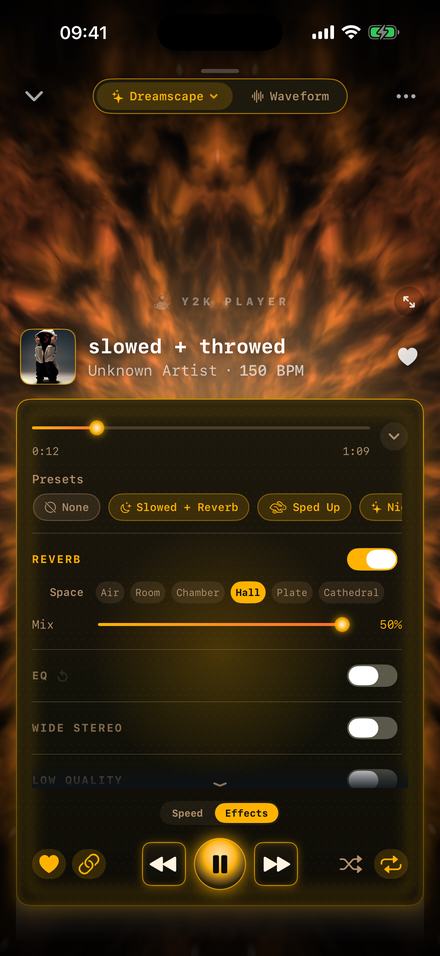
A preset is a starting point with a name on it, not a destination
Tap Slowed + Reverb and the tempo is 0.85× with the reverb on. Pull it to 0.78× and you have walked from one word on this page towards another, by ear. None puts it all back, tempo and pitch included.
Questions the definitions raise
The ones that come up as soon as two of these words are put side by side.
What is the difference between nightcore and sped up?
The pitch. A sped up edit usually keeps the original key and simply runs faster; nightcore lets the pitch rise with the tempo, the way a record does. Sped up edits cluster around 125%, nightcore around 135%. In Y2K Player it is one button — the link between Tempo and Pitch — and switching it changes which of the two words you are making.
Is slowed and reverb the same as daycore?
No. Both slow the song and drop the pitch with it, but slowed and reverb is defined by the room added on top and usually sits at 0.80× to 0.90×. Daycore goes further down, 0.70× to 0.80×, and needs no reverb at all — the point is the changed voice, not the atmosphere.
Does chopped and screwed have to be chopped?
By the name, yes. Screwed is the slowing and the pitch drop; chopped is the hand-made repeats over the top. A song that has only been slowed is screwed, not chopped and screwed — which describes most of what is posted under the full name.
Can I make phonk out of a song I already have?
Not really, and anything offering a phonk button is offering you a distortion knob. Phonk is a genre built from particular samples and arrangement choices, not a transform applied to a finished song. You can push a track towards how those records sound — distortion, chopped repeats, degraded highs — but the result is a phonk-flavoured edit rather than phonk.
What does wet/dry actually control?
How much of what you hear has been through the effect. Fully dry is the untouched song; fully wet is the effect alone. It is labelled Mix in Y2K Player, and the reverb one stops at 50% because past halfway the dry song is quieter than the room it is sitting in.
Does changing the speed damage the audio?
Nothing is written to the file — speed, pitch and every effect are settings the song carries, and the original is untouched. Whether it sounds damaged depends on the method: reading a file faster or slower is effectively lossless, while stretching time and shifting pitch at once is the case that costs the most, which is why the two jobs are split between two different units.
Where to go next
- Slowed and reverbThe 0.85× sound in full, and which of the six rooms to reach for.Open →
- NightcoreThe pitch-linked speed-up, and where it stops being an edit.Open →
- Sped up songs110% to 135%, and what each part of that range does to a track.Open →
- Slowing a song downPractising and transcribing, where the key is meant to stay put.Open →
- The Phonk SoundTempo, drive & chop · iPhone & iPadOpen →
Ten words. Two sliders.
Everything defined on this page is the tempo, the pitch link, and whether you added a room.
Free to download and keep. Pro is a one-time purchase — buy it once and it never renews.